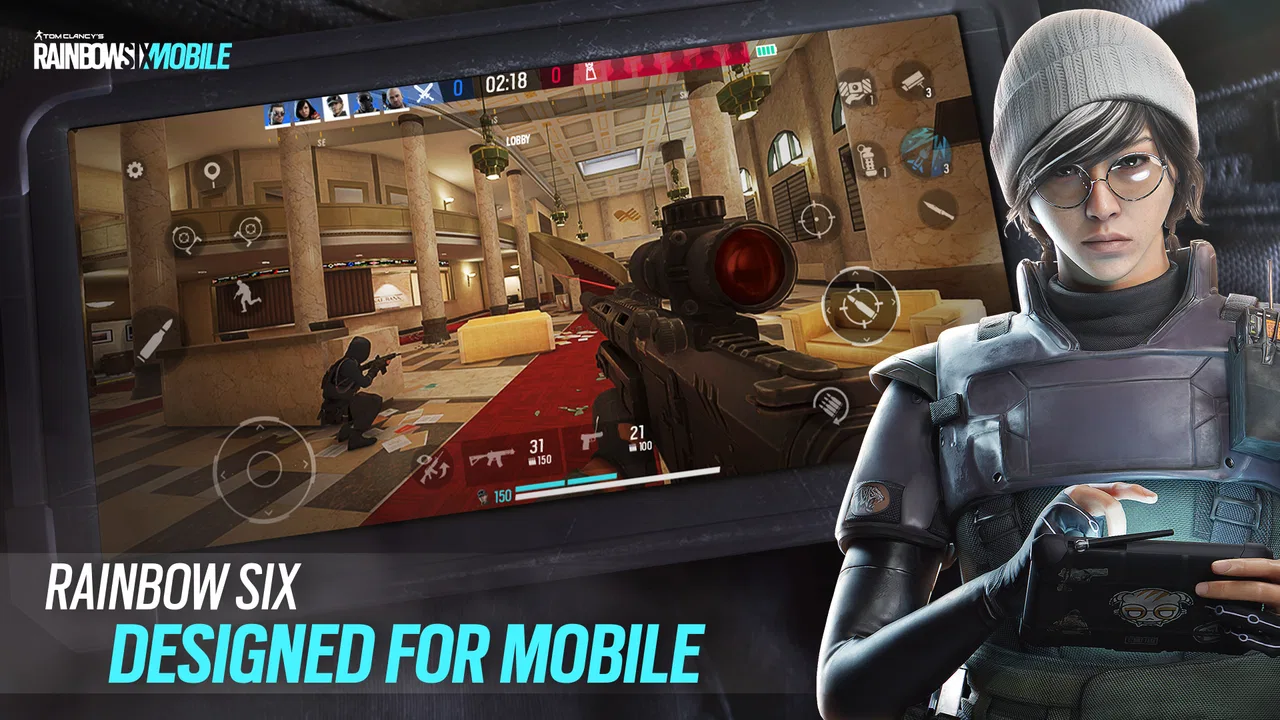
Rainbow Six Mobile
- 4.5
- Rating
- 10.00M
- Installs
- Free
- Price

 Analysis by App-foxy
Rainbow Six Mobile is a free action game that caught my attention because it tries to bring the tense, information-heavy style of Rainbow Six to a smaller screen. Rather than treating every round like a simple run-and-gun match, it asks me to think about positioning, timing, sound, and the limited information available to both teams. That focus is the one capability I kept coming back to: the game makes deliberate decision-making matter even when I am playing on a phone.
That sounds appealing, but it also explains why this is not a perfect fit for every mobile player. If you want a quick shooter where reflexes alone carry you, the slower tactical rhythm may feel restrictive. If you enjoy learning maps, coordinating with teammates, and making a plan before committing to a fight, the design has much more to offer. My experience is that the game rewards patience in a way many mobile action titles do not.
Why its tactical information matters more than raw aim
The most important strength here is not simply that Rainbow Six Mobile is an action game. It is the way the match encourages me to gather information before I act. A doorway, corridor, or room is rarely just scenery. It becomes a question: what can I safely see, what might be hidden, and how much time can I spend checking before the situation changes?
You May Also Like

 Blood Strike: 2.5 Anniversary
Blood Strike’s Loadouts Turn Every Drop Into a Tactical Gamble
A close look at Blood Strike’s custom loadouts: how fast access to signature weapons reshapes its battle royale rhythm, rewards preparation, and narrows the gap between fights.

 Pandora - Music & Podcasts
Pandora’s Music Is Easy to Start, but Harder to Recover
Pandora’s strength is its low-effort path from a seed to a station. Its weak spot is how much confidence it asks you to place in connection, setup, and quiet recovery.

 8 Ball Pool
 Is Built on Rivalries, Rematches, and Routine
A close look at the rivalries, rematches, shared routines, and unanswered safety questions that turn a quick pool match into a persistent mobile community.

 Samsung Music
’s Quiet Strength Is Playing What You Already Own
Its reach comes less from spectacle than from dependable access to a personal library. That simplicity is both the app’s strongest retention engine and its ceiling.

 AccuWeather: Weather Radar
AccuWeather Review: A Quick, Clear Forecast for Everyday Decisions
For everyday plans, the best forecast is the one you can understand quickly. AccuWeather makes rain timing, radar, and local conditions easy to act on, with a few trade-offs.

 Hill Climb Racing
Why Hill Climb Racing Still Turns Crashes Into One More Run
A tiny car, a bumpy hill and one more upgrade: Hill Climb Racing keeps resurfacing because its simple chaos makes every near-miss feel personal.
More From Our News Desk



That changes the feel of a round. In a conventional mobile shooter, I can often recover from a poor choice by sprinting away or winning a quick duel. Here, a careless entry can leave me exposed before I have understood the room. I found myself paying attention to angles and movement instead of constantly searching for the next target. The result is a more thoughtful kind of pressure.
The real advantage is information before confrontation. When I slow down long enough to understand the space around me, I make better choices and create more useful openings for my team. This does not remove the importance of aim, but it gives positioning and awareness a larger role than they usually receive on a phone.
The game is developed by Ubisoft Nova, and its identity is clearly aimed at players who already like the Rainbow Six style or want a more tactical alternative to faster mobile shooters. It is available at no purchase price, which makes trying the basic experience easy. However, optional purchases range from $0.69 to $179.99 per item, so I would approach the store carefully and decide in advance how much, if anything, I want to spend.
How the information-focused approach works during a match
In practice, the capability appears through the way I prepare for an engagement. I do not treat every visible opening as an invitation to rush. I first consider whether I have a safe angle, whether a teammate can support the move, and whether entering now gives the other side an easy opportunity to catch me. That short pause often makes the difference between a useful push and an unnecessary elimination.
On a touch screen, this process is especially important. Mobile controls can make quick corrections less comfortable than a mouse or controller, so I prefer to reduce the number of frantic decisions I need to make at once. Holding a favorable position and waiting for a clearer moment can be more reliable than trying to out-turn an opponent in a chaotic close-range exchange.
This is also where the game separates itself from a casual shooter. I have to think about the shape of the room, the route I am taking, and what information my teammates may or may not have. Even when I lose a round, I can usually identify a decision that caused the problem: entering too quickly, exposing myself while checking an angle, or moving without enough support.
One useful habit is to treat every approach as a small information-gathering exercise. Instead of immediately committing, I check what I can from cover, communicate what I notice, and only then decide whether to continue. That workflow feels slower at first, but it reduces the number of avoidable mistakes. It is particularly helpful for players who are still learning the maps and do not yet know which spaces are dangerous.
Another practical lesson is to separate “I can see the route” from “the route is safe.” A clear corridor can still be a poor path if it leaves me visible from several directions. I get better results when I think about where an opponent could be standing, not only what is directly in front of me. That small mental adjustment makes the tactical design easier to understand.
There is a trade-off in this method. A careful player can sometimes spend too long waiting and allow the other team to improve its position. Information is valuable, but it is not a substitute for action. The strongest rhythm I found was to gather enough information to make a reasonable decision, then commit decisively instead of endlessly searching for certainty.
The best everyday scenario for playing
I think the game works best when I have a focused block of time rather than a few distracted minutes. For example, after work I might play while sitting somewhere quiet, with notifications turned off and headphones available. I can use the first round to settle into the controls, then apply what I learned about the map and my own habits in the next match.
That setting matters because tactical play becomes frustrating when I am interrupted. Missing a sound cue, losing track of a teammate, or having to look away during an important moment can turn a careful plan into a bad engagement. The game is free, so it is easy to open casually, but I would not describe every match as ideal for multitasking.
A good beginner routine is to choose one narrow goal for a session. I might focus on staying alive while supporting a teammate, learning safer routes through one area, or avoiding unnecessary fights. This is more useful than trying to master everything at once. It also gives me a way to measure improvement even when the final result is not a win.
For a group of friends, the information system becomes more enjoyable because communication has a clear purpose. Calling out a location, warning about a dangerous angle, or telling teammates that I am ready to move feels more meaningful than simply announcing that I saw an opponent. The game rewards concise communication, so long explanations in the middle of a round can be less helpful than a short, timely call.
Solo players can still enjoy the experience, but the learning curve may feel steeper. Without familiar teammates, I have less control over the pace of a push and may need to adapt to people who prefer very different approaches. I would recommend solo play for learning the game’s rhythm, while regular groups are better for players who want to explore the tactical side more deeply.
Where the approach becomes demanding
The same deliberate design that makes Rainbow Six Mobile distinctive can also create friction. A player who expects immediate action may interpret the slower moments as inactivity. I sometimes had to remind myself that waiting was part of the decision, not evidence that nothing was happening. That mindset is essential if the game is going to feel satisfying.
Touch controls add another layer of difficulty. Even with practice, there are moments when I want to adjust my view, move, and react at the same time. On a larger screen, the interface may feel easier to manage than on a compact phone, but the experience still depends on personal comfort and familiarity with mobile controls. Players who strongly prefer precise physical input may find a traditional console or computer version more natural.
There is also a social trade-off. Tactical matches are more rewarding when teammates share information, but coordination can be inconsistent when everyone has a different goal. A player who wants to practice careful positioning may struggle if the rest of the team repeatedly rushes. Conversely, someone who enjoys aggressive plays may feel held back by a group that waits too long.
The free entry point is convenient, but the presence of in-app purchases deserves attention. I would not begin by spending money simply because an item looks useful or attractive. First, I would learn the controls, decide whether the match flow suits me, and see whether I am still enjoying the game after several sessions. That approach protects the value of the free download and makes any later purchase a deliberate choice rather than an impulse.
The Teen content rating is another reason I would consider the intended audience before installing it for a younger player. Parents should check the game directly and decide whether its action-focused presentation and online multiplayer setting are appropriate for their household. I would also recommend keeping account spending under control, especially because the purchase range extends from small optional items to much larger individual purchases.
Performance expectations should be realistic as well. The current version is 2.0.001 and requires at least Android 9, so compatibility is not aimed at very old devices. Even when a phone technically meets the operating-system requirement, the quality of play can depend on how comfortably it handles a visually demanding action game. I would close other apps, keep the device charged, and avoid judging the game during a moment when the phone is already struggling.
Who benefits most from the tactical focus
The best audience is someone who enjoys action but wants more than constant shooting. If I like studying a map, predicting an opponent’s next move, and improving through small adjustments, the game gives me plenty to think about. It is also a good choice for friends who want a mobile activity where communication and shared planning matter.
Players coming from fast arena shooters may need to change their habits. Speed is still useful, but rushing without information is often a liability. I would suggest approaching the game as a learning process rather than expecting immediate dominance. The first goal should be understanding why an engagement went wrong, not simply blaming aim or teammates.
It is less suitable for someone who wants a short, low-commitment distraction with predictable solo progress. The tactical structure means that the quality of a match can depend on concentration, teammates, and the willingness to learn from mistakes. If I only have a minute between tasks, I would choose a simpler mobile game. If I have enough time to settle in and pay attention, this one has a stronger chance of holding my interest.
Compared with the usual alternatives in mobile action, Rainbow Six Mobile stands out through its emphasis on controlled engagements. A faster shooter may deliver more immediate excitement, while a casual action game may be easier to understand without practice. This game asks for more from me, but it also gives my choices more weight. The trade-off is clear: less instant accessibility in exchange for more satisfying improvement when I learn how to read a situation.
The large existing audience suggests that the concept has broad appeal. The game has an average rating of 4.6 from around 90 thousand ratings, with over 10 million installs, so it is not an obscure experiment that only a handful of players have tried. I still would not treat popularity as proof that it will suit me personally. The important question is whether I enjoy the deliberate pace and the responsibility of making decisions with incomplete information.
My recommendation after spending time with it
Rainbow Six Mobile is worth trying if I want a serious-feeling mobile action game built around awareness rather than nonstop movement. Its strongest capability is the way information shapes every encounter: checking an angle, choosing a route, waiting for support, and committing at the right moment. Those choices make the game feel different from a standard phone shooter, and they create a clear path for improvement.
I would start free, play with a calm mindset, and avoid judging the experience after one chaotic match. Give the controls time to become familiar, use short communication when playing with others, and set a personal goal for each session. If the slower tactical rhythm feels rewarding, the game can become a compelling regular activity. If I prefer instant action, uninterrupted solo play, or the precision of a physical controller, another option will probably be a better match.
The global launch is set for February 23, 2026, and the game carries a Teen rating. As a free title from Ubisoft Nova, it has an accessible starting point, but the optional purchase range means I would keep spending firmly under my control. My final view is positive but specific: this is not simply a smaller shooter. It is a mobile tactical game for people who enjoy making the right decision before pulling the trigger.
FAQs for Rainbow Six Mobile
01What is Rainbow Six Mobile, and how does it differ from the console version?
Rainbow Six Mobile is the portable adaptation of the popular tactical shooter game, Rainbow Six Siege, designed specifically for Android and iOS devices. While it retains the core gameplay mechanics such as strategic team-based combat, it features optimized controls and graphics to suit mobile platforms, offering a streamlined yet immersive experience.
02Is Rainbow Six Mobile free to play, and are there in-app purchases?
Yes, Rainbow Six Mobile is free to download and play. However, it includes in-app purchases that allow players to buy cosmetic items, battle passes, or other enhancements. These purchases are optional and do not affect the core gameplay, ensuring that players can enjoy the game without spending money.
03What are the minimum device requirements to play Rainbow Six Mobile?
To enjoy Rainbow Six Mobile smoothly, players need a device with at least 3GB of RAM and a stable internet connection. The game is optimized for recent versions of Android and iOS, so having an up-to-date operating system is recommended for the best experience. Specific device compatibility can be checked on the game's download page.
04Can I play Rainbow Six Mobile with my friends, and how does the matchmaking system work?
Yes, Rainbow Six Mobile supports multiplayer gameplay, allowing you to team up with friends or join matches with players from around the world. The matchmaking system pairs players based on their skill level to ensure balanced and competitive matches, maintaining the game's strategic depth and excitement.
05Does Rainbow Six Mobile require a constant internet connection?
Yes, Rainbow Six Mobile requires a constant internet connection to play. This is essential for accessing multiplayer features, real-time matchmaking, and updates. A stable connection ensures smooth gameplay and prevents disconnections during matches, which is crucial for maintaining the game's competitive nature.
Pros
- High-quality graphics and immersive gameplay.
- Diverse range of operators to choose from.
- Real-time multiplayer matches for competitive play.
- Frequent updates with new content and features.
- Intuitive controls optimized for mobile devices.
Cons
- Requires a stable internet connection to play.
- In-app purchases can be expensive over time.
- High battery consumption during extended play.
- Limited offline gameplay options available.
- Can be challenging for new players to learn.

Rainbow Six Mobile
Gallery